One day, a country wakes up and cannot access its foreign reserves
Banks refuse transactions
Global payment systems no longer respond
How is a country’s sovereignty impacted when it can no longer move money?
Financial Rails Are Power
Economic power is an instrument of national power
Financial rails determine who can transact, settle, and survive pressure
Blockchain-based financial systems introduce alternative rails and new control points
Doctrinal Framing
Sanctions, reserves, payment networks, and settlement access are part of the economic instrument of statecraft. When the infrastructure of money changes, the way states project power and absorb pressure changes too.
What We’re Analyzing Today
Now that we have covered CBDCs, stablecoins, and broad sovereignty questions, we can shift to specific country and regional cases.
How are governments responding when blockchain changes:
payment chokepoints
financial visibility
access to dollar-like digital instruments
How Blockchain Changes State Power
State Concern
Public blockchains reduce some traditional chokepoints
Stablecoins and crypto rails can move value across borders faster
States may lose leverage if activity shifts outside older intermediated systems
State Opportunity
Public ledgers also make transactions more traceable at scale
Exchanges, stablecoin issuers, and service providers create new control points
Digital finance can become a tool of sanctions resilience, surveillance, or monetary competition
Strategic Approaches to Cryptocurrency
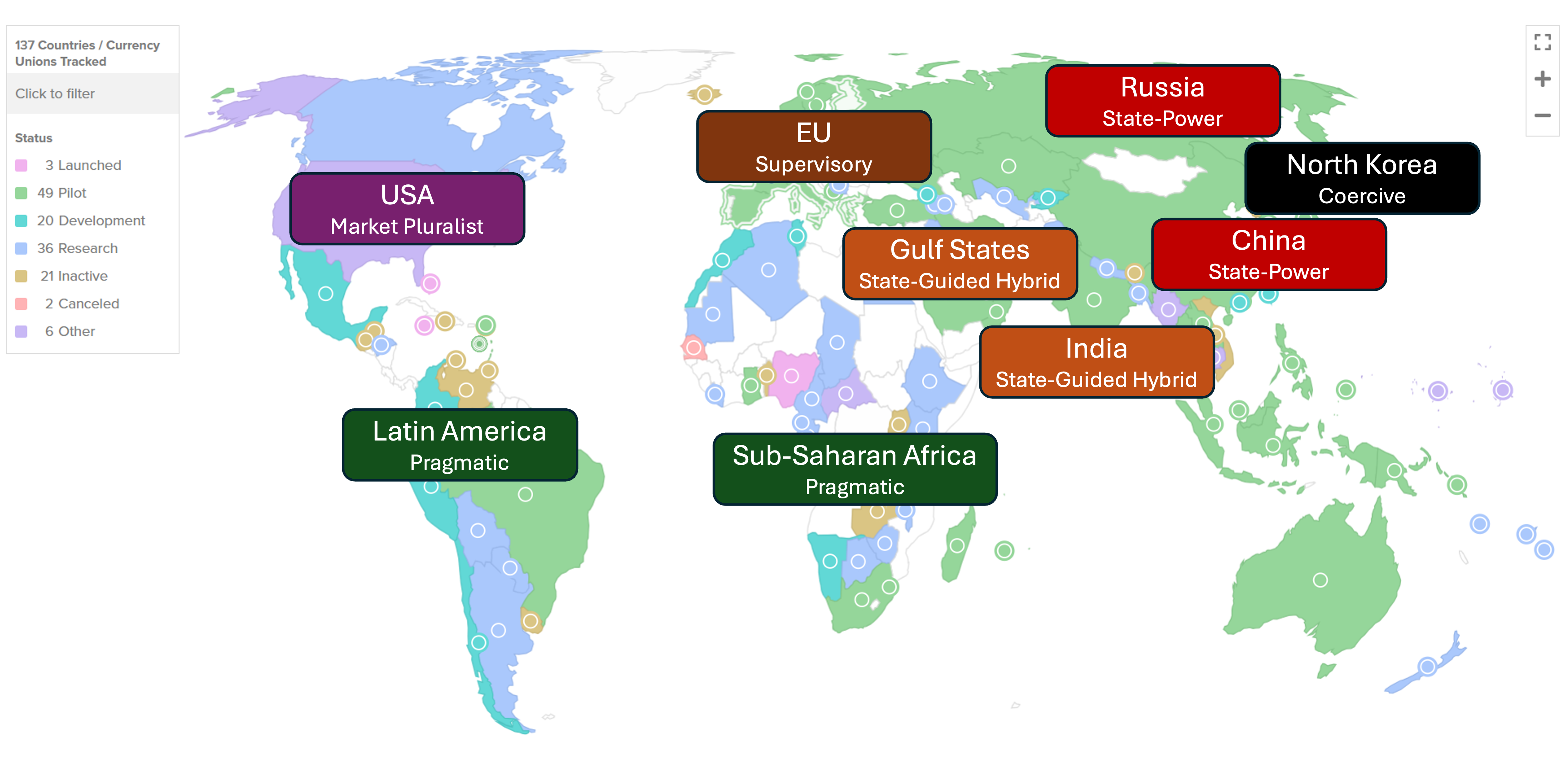
States do not follow one universal crypto model; they fall along a policy spectrum.
These choices reflect national interests: innovation, monetary sovereignty, sanctions resilience, surveillance, and access to payments.
The next slides will test this framework against nine country and regional cases.
Model: Market-driven innovation with strategic dollar protection
The USG increasingly treats blockchain and dollar-backed stablecoins as tools of competitiveness and dollar reach
Neither fully pro- or anti-crypto
Oversight remains fragmented across Congress, Treasury, the Federal Reserve, and market regulators
Federal policy moved sharply against a retail CBDC in 2025
Flag source: Wikimedia Commons / Wikipedia
United States: Impact Signals
Executive Order 14178 (January 23, 2025)
Made support for digital assets and open blockchain development an explicit federal policy goal
Directed agencies to propose a federal digital-asset framework
Prohibited agencies from establishing or promoting a U.S. CBDC
Stablecoin Policy Shift in 2025
The GENIUS Act framework creates a federal path for regulated payment stablecoins backed by reserves and subject to supervisory standards
Treasury framed regulated stablecoins as a way to expand global dollar use and demand for U.S. Treasuries
Stablecoins are more politically palatable than a retail CBDC because they preserve private issuers, bank intermediation, and distance from direct state retail control
But that choice still carries risk: private firms and foreign holders can become important nodes in dollar liquidity and reserve demand
EU: Overview
Model: Supervisory integration with strategic autonomy
The EU treats crypto predominantly as a supervision and sovereignty question
MiCA (Markets in Crypto-Assets) regulation gives the EU one crypto rulebook across member states before broader market expansion
The digital euro remains part of a long-term payments-autonomy strategy
The posture is coordinated, bloc-wide, and more state-guided than the US
Flag source: Wikimedia Commons / Wikipedia
EU: Impact Signals
MiCA as a bloc-wide rulebook
MiCA gives the EU one supervisory framework for crypto issuers, exchanges, and service providers across the single market
It is meant to reduce national fragmentation and bring stablecoins and crypto firms under consumer-protection and prudential rules
It has been welcomed as regulatory clarity by some firms, but it also raises compliance costs and may concentrate activity in the best-prepared jurisdictions
The digital euro project
The digital euro project aims to preserve public money in digital payments and reduce dependence on non-European payment platforms
The European Commission presented the legal package on June 28, 2023, keeping open the option of a retail digital euro
The project still faces political and practical questions about privacy, adoption, and whether Europeans see enough benefit to justify a new payment layer
China: Overview
Model: State-capacity first, with prohibition of private crypto speculation
China restricts private crypto speculation while advancing state-directed digital money
e-CNY is built inside a state-observable payment architecture
Blockchain is accepted where it strengthens official payments, trade, or administrative capacity
The goal is state capacity and control
Flag source: Flagcdn
China: Impact Signals
e-CNY is built for traceability under state rules
People’s Bank of China (PBOC) materials describe e-CNY as using managed anonymity, or “anonymity for small value and traceable for high value”
In practice, that means e-CNY is not designed to work like cash-level anonymity at scale
Larger or suspicious flows remain visible to authorities for compliance and enforcement
Critics worry this fits a broader control architecture
Chinese officials present e-CNY as privacy-protective, but only within a state-managed data system
That raises surveillance concerns because a state-linked payment system can make transaction activity easier to monitor, map, and analyze
It also raises censorship concerns because a payment system under centralized control can be used to restrict, freeze, or deny transactions in line with state policy
Russia: Overview
Model: State-capacity under sanctions pressure
Sanctions pressure pushes Russia to seek payment channels less dependent on Western banks, messaging networks, and dollar-linked intermediaries
The digital ruble and other state-led digital-finance experiments aim to widen foreign-trade settlement options
Many of these experiments still depend on exchanges, stablecoins, and intermediaries that can be frozen, pressured, or cut off
Flag source: Wikimedia Commons / Wikipedia
Russia: Impact Signals
State rollout of the digital ruble
Russia has developed the digital ruble over several years as a state-run alternative within its domestic payment system, and plans to begin a large-scale introduction on September 1, 2026, moving past the pilot stage
The opportunity is stronger domestic payment control, but the model also raises concerns about state visibility, limited user appeal, and whether it can meaningfully reduce external financial pressure
Foreign-trade digital-asset experiments under sanctions
In February 2024, the State Duma, Russia’s lower house of parliament, approved use of digital currency for international payments as part of a sanctions-era search for alternative trade rails
But the March 6-7, 2025Garantex actions showed how quickly those alternatives can run back into chokepoints when exchanges, stablecoin issuers, and cross-border enforcement coordination are still involved
North Korea: Overview
Model: Coercive revenue generation under sanctions
North Korea has evolved from isolated cyber theft into a more sustained crypto-revenue strategy
State-linked operators steal from exchanges, bridges, and service providers, then use laundering networks to generate revenue for sanctioned state activity
The strategy depends on covert cyber capability, not open domestic crypto adoption
Flag source: Wikimedia Commons / Wikipedia
North Korea: Impact Signals
State-linked theft at industrial scale
Chainalysis reported that North Korea-linked hackers stole about $1.34 billion across 47 incidents in 2024, up sharply from roughly $660.5 million across 20 incidents in 2023
This scale suggests a sustained state revenue strategy rather than isolated criminal activity
Stolen crypto can support procurement, sanctions evasion, and other state-linked activities once it is laundered into usable funds
The U.S. Treasury sanctioned Blender.io in May 2022 and later sanctioned Sinbad.io in November 2023 for laundering DPRK-linked stolen virtual currency
In both cases, U.S. officials tied the services to the Lazarus Group, the DPRK-linked hacking organization associated with major exchange and bridge thefts
These sanctions show that DPRK laundering networks are sophisticated, but they still create traces that states can identify, designate, and disrupt
India: Overview
Model: Regulated integration with monetary caution
India moved from early near-ban debates to controlled tolerance
The digital rupee is the state-approved path for payments innovation
Tax, compliance, and Reserve Bank of India (RBI) warnings reflect concern about volatility, capital flight, and monetary control
Innovation is allowed, but only on terms the state can supervise closely
Flag source: Wikimedia Commons / Wikipedia
India: Impact Signals
The digital rupee remains the official digital-money path
The project is framed around safer payments, settlement efficiency, and state oversight, keeping digital-money experimentation inside the existing monetary architecture
The result is a restrictive environment: crypto is not fully banned, but it is clearly not being welcomed as a mainstream monetary alternative
Gulf States: Overview
Model: Strategic diversification through regulated hubs and payment sovereignty
The UAE and Saudi Arabia use licensed crypto markets and payment experiments to build regional influence, with the UAE also aiming for global hub status
Hub-building: Attracting firms, capital, and financial tech activity under state-set rules
Cross-border payment projects reflect a push for faster settlement and more regional autonomy
The objective is to attract firms and capital without surrendering compliance, AML, and market-integrity oversight, though tighter rules also raise costs for smaller or less mature firms
The hub-building strategy is progressing: Dubai has kept updating its rulebooks, attracting major firms, and positioning itself as a regulated gateway for regional and global crypto business
Gulf states are testing new cross-border payment rails
The UAE and Saudi Arabia launched Project Aber in 2020 to test whether a shared wholesale digital currency could make cross-border interbank settlement faster and more direct
Stablecoins are central because users and businesses need dollar-like instruments for savings and cross-border transfers
Nigeria’s SEC launched ARIP in June 2024, showing a shift from uncertainty toward formal onboarding of virtual asset service providers (VASPs) even as demand continues to outpace regulatory stability
South Africa: licensing and institutional integration
The FSCA reported in December 2024 that it had received 420 crypto asset service provider (CASP) licence applications and approved 248, showing crypto activity moving into licensed financial channels rather than remaining mostly informal or retail-only
Project Khokha and broader bank participation show closer links between crypto markets and traditional finance, though tighter licensing and compliance standards may favor larger firms over smaller entrants
Competing Financial Infrastructures
Legacy bank rails
SWIFT messaging and correspondent banking
State digital rails
CBDCs and shared central-bank settlement platforms
Open blockchain rails
Public chains, stablecoins, and exchange-linked networks
The geopolitical question is no longer whether alternatives exist, but which rails states choose to trust, shape, or resist.
Closing the Geopolitical Discussion
What now seems settled:
blockchain and digital money are part of sanctions, payments, surveillance, and monetary competition
states now have recognizable postures, not just isolated experiments
What remains unresolved:
which rails will scale and gain trust
whether digital finance reinforces existing monetary hierarchies or redistributes them
whether new systems decentralize power or simply create new forms of control
References
[1]
U.S. Dept. of Treasury, “U.S. Treasury Sanctions Notorious Virtual Currency Mixer Tornado Cash,” United States Government, Washington, D.C., Press Release, Aug. 2022. Accessed: Oct. 28, 2025. [Online]. Available: https://home.treasury.gov/news/press-releases/jy0916