Distributed Systems
Section III: Distributed Systems Fundamentals
April 9, 2026
What Is a Distributed System?
Working definition: Multiple nodes that communicate over a network to appear as one system to users.
- Examples: web apps with external auth, multiplayer games, file sync, P2P sharing.
- Key properties: resistant to independent failures and unreliable networks; shared ownership.
- Design goal: deliver correct, available service despite those limits.
Client–Server: Centralized Index and Control
Definition: Clients request data or service from a centralized server (or cluster) that holds authority.
- Strengths:
- Simple mental model
- Easier to govern and enforce policy
- Fast, centralized search and indexing
- Weaknesses:
- Control and failure are concentrated (single point of failure)
- Scaling hotspots (the server can become a bottleneck)
- Real-world pattern: Centralized discovery combined with direct data transfer (e.g., DNS, traditional web apps).
Blackout at 8 PM: Can We Still Share?
- Imagine an outage of major internet services (AWS, Google, Cloudflare, etc.).
- Your phone has data; your home internet works.
- You can’t reach Google, but you ccould share a file directly with your neighbor - but how?
- Can we still share without a central server?
- What if the internet/cell service are completely down?
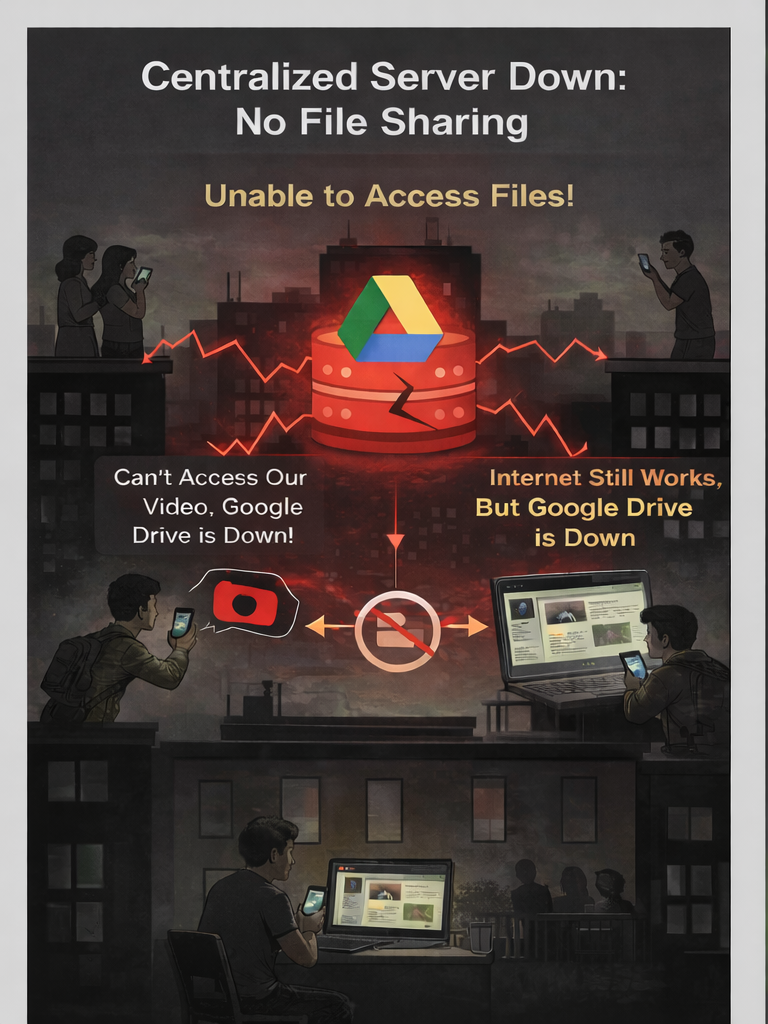
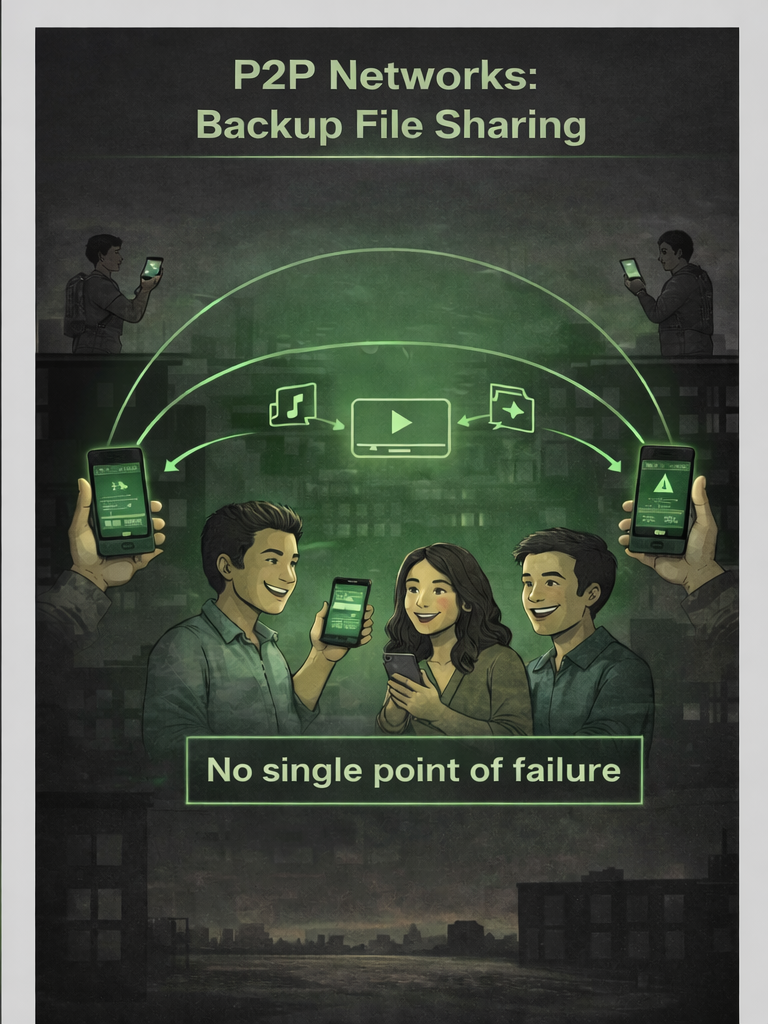
Centralized vs. P2P
This is the core idea of a Peer-to-Peer (P2P) network.
- P2P networks have been around for decades and were central to early file-sharing systems.
- ARPANet (1966) \(\rightarrow\) early packet-switched network that helped shape the Internet
- Usenet (1979) \(\rightarrow\) early distributed discussion system widely associated with the early Internet era
- DNS (1983) \(\rightarrow\) naming infrastructure, essential to the world wide web
- They do not rely on a central server to work!
Centralized vs. P2P
Takeaway
P2P overlays are often less efficient than a centralized hub because messages may travel through more hops and coordination is harder. That extra complexity buys robustness: no single chokepoint controls availability, censorship, or total failure.
Centralized vs. Decentralized: Trade‑offs
Centralized
- Clear control and governance
- Strong consistency and observability
- Single point of failure and policy risk
Decentralized (P2P)
- No central chokepoint; resilient to takedown
- Autonomy for participants; local control
- Higher coordination cost; variable consistency
Why Distribute? Motivations and Risks
Motivations
- Scale out capacity and storage
- Place compute near users to reduce perceived delay
- Fault isolation and graceful degradation
- Autonomy between teams or organizations
Risks
- Coordination complexity and new failure modes
- Latency and bandwidth limits
- Security, trust, and heterogeneous administration
Distributed Failures
- Node-level, service-level, and network-level failures are different in scope and impact.
- Node-level failures affect one machine or process.
- Service-level failures break a shared application or dependency used by many nodes.
- Network-level failures partition links, racks, zones, or regions and can disrupt multiple services at once.
- Hidden external dependencies can turn a small fault into a major outage.
- Failures may be contained with isolation, timeouts, and graceful degradation.
Distributed Computing and Blockchain
- Blockchains are inherently distributed systems.
- A local-only blockchain would be little more than a personal log; the value comes from shared state across many machines.
- Bitcoin combined distributed networking, cryptography, and incentives into a system with no central operator.
- Understanding failure, propagation, and coordination helps us understand blockchain design constraints.
Availability, MTTF, and MTTR
- Availability ≈ (time the service is operational) ÷ (total time users need it).
- MTTF (Mean Time To Failure): average time a system runs before failing.
- MTTR (Mean Time To Repair): average time to recover and restore service after failure.
- To improve availability: increase MTTF (fail less often) and reduce MTTR (recover faster).
- Core design levers: retry failed operations and replicate critical components.
The Eight Fallacies
- What they are: A checklist of common bad assumptions engineers make about networks in distributed systems.
- Why they matter: These assumptions cause fragile designs, outages, security gaps, and poor user experience.
- Blockchain relevance: Blockchains are distributed systems on hostile, unreliable networks, so each fallacy shows up in practice.
- Historical origin: The fallacies were developed over time at Sun Microsystems in the 1990s, largely from internal engineering experience.
- Attribution note: The first seven are often credited to L. Peter Deutsch; James Gosling is commonly credited with adding the eighth.
Think of these as a pre-flight checklist: before trusting a design, ask which fallacies it accidentally assumes.
Fallacy #1: The Network Is Reliable
- Fallacy: Messages will get through if we send them.
- Reality: Networks drop, duplicate, reorder, and delay packets; partial failure is normal.
- Failure mode: A payment API call times out after server-side success, and the client assumes failure.
- Design response: Use timeouts, retries with backoff, and idempotent operations with request IDs.
- Blockchain lens: Transaction and block propagation is best-effort, not guaranteed.
Where would we see this in Bitcoin or Ethereum propagation behavior?
Fallacy #2: Latency Is Zero
- Fallacy: Distance and round trips are negligible.
- Reality: Latency is unavoidable and accumulates across protocol steps.
- Failure mode: A chatty protocol with multiple back-and-forth exchanges causes visible user lag.
- Design response: Reduce round trips, batch requests, cache reads, and colocate tightly coupled services.
- Blockchain lens: Propagation delay affects mempool view, confirmation speed, and fork creation.
What user-facing blockchain behaviors are really latency artifacts?
Fallacy #3: Bandwidth Is Infinite
- Fallacy: We can broadcast freely without cost or congestion.
- Reality: Throughput is finite, shared, and uneven across participants.
- Failure mode: Flooding queries or large payload gossip saturates links and starves useful traffic.
- Design response: Compress data, cap message size, deduplicate inventory, and avoid blind broadcast.
- Blockchain lens: Bigger or more frequent messages disadvantage low-bandwidth nodes and strain decentralization, many blockchain efforts to minimize amount of data transmitted.
How can bandwidth pressure quietly centralize a network?
Fallacy #4: The Network Is Secure
- Fallacy: Peers and links are trustworthy by default.
- Reality: Networks are adversarial; spoofing, eclipse attempts, and malicious peers exist.
- Failure mode: A node accepts biased peer data and gets a distorted view of the network.
- Design response: Authenticate data, diversify peers, validate independently, and enforce rate limits.
- Blockchain lens: Signatures protect authenticity, but not peer honesty or availability; public blockchains must handle malicious nodes and network connections.
What attacks remain possible even with strong cryptographic signatures?
Fallacy #5: Topology Doesn’t Change
- Fallacy: Node membership and paths stay stable.
- Reality: Churn is constant; nodes join, leave, reboot, and move.
- Failure mode: Static peer assumptions cause partitions or stalled gossip during churn events.
- Design response: Continuous peer discovery, health-based eviction, and resilient rebroadcast policies.
- Blockchain lens: Gossip and peer discovery have to tolerate constant churn - nodes are always leaving or joining the network.
What breaks if your design assumes a stable peer list?
Fallacy #6: There Is One Administrator
- Fallacy: One authority controls policy, upgrades, and operations.
- Reality: Real systems span teams and organizations with different incentives, timelines, and governance.
- Failure mode: Incompatible upgrades or policy divergence split behavior across clients or operators.
- Design response: Version negotiation, staged rollouts, explicit governance, and backward compatibility windows.
- Blockchain lens: Permissionless/public networks coordinate upgrades without a single administrator.
Who gets to decide protocol changes in a decentralized network?
Fallacy #7: Transport Cost Is Zero
- Fallacy: Moving data has negligible monetary and resource cost.
- Reality: Egress, relay, storage, and compute costs shape architecture viability.
- Failure mode: High relay or egress burden pushes smaller operators offline, reducing decentralization.
- Design response: Efficient relay protocols, pruning or light modes, and incentive-aware resource budgeting.
- Blockchain lens: Node operating cost directly affects participation and diversity.
Who pays for “free” decentralization in practice?
Fallacy #8: The Network Is Homogeneous
- Fallacy: All nodes run similar hardware, software, and links.
- Reality: Heterogeneity is the norm across clients, OSes, devices, and connection quality.
- Failure mode: Assumptions tied to one stack cause interoperability bugs and uneven behavior.
- Design response: Protocol conformance testing, feature negotiation, and graceful fallback paths.
- Blockchain lens: There is no oversight on who can join, and that means making no assumptions about the devices connecting; multi-client diversity improves resilience but increases compatibility burden.
When does client diversity increase safety, and when does it increase risk?
The Eight Fallacies of Distributed Computing
- The transport network is reliable.
- Latency is zero.
- Bandwidth is infinite.
- The system network is secure.
- Topology doesn’t change.
- There is one administrator.
- Transport cost is zero.
- The network is homogeneous.
Case Study: Napster

Napster was an early 2000s P2P file-sharing network that caused significant controversy by enabling widespread music piracy.
Famously shut down in 2001 after a court ruling found it liable for contributory copyright infringement.
- Napster’s network featured a hybrid P2P model consisting of:
- centralized index: users register file metadata with Napster’s servers.
- Peer-to-peer transfer: actual files move directly between users.
- Result: fast search, but central control and a central point of failure.
Case Study: Gnutella & “Flooding”
![]()
-
An early P2P file-sharing network that showed the pros and cons of an unstructured, “flooding” design.

How Gnutella Worked:
- Join: A new peer (a “servent”) connects to one or more known peers.
- Search: To find a file, the peer sends a
Querymessage to all its neighbors. - Flood: Those neighbors send the
Queryto their neighbors, and so on. A “Time-to-Live” (TTL) counter stops the flood from going on forever. - Respond: If a peer has the file, it sends a
QueryHit(a “Here it is!”) message back along the same path the query came from.
Problems:
- Massive Traffic: A single query could create a “broadcast storm,” flooding the network with duplicate messages.
- Poor Scaling: The network couldn’t grow large without being overwhelmed by search traffic.
Gnutella’s Fix: Supernodes & “Smart Flooding”
To solve its scaling problem, Gnutella 0.6 created a two-level hierarchy. This idea is central to how blockchains work today.
The Gnutella 0.6 Model
- Supernodes (or “Ultrapeers”): Peers with good bandwidth and uptime. They acted as powerful hubs, indexing the files of all the weaker peers connected to them.
- Leaf Nodes: Regular users (like on a home PC). They would connect only to a Supernode and send their searches only to that Supernode.
The “Smart Flood”
- A Leaf Node sends a query to its Supernode.
- The Supernode checks its own index of files from all its other leaves.
- If no match is found, the Supernode only floods the query to other Supernodes.
This was a huge improvement. It stopped millions of weak leaf nodes from participating in the network-clogging flood.
The Blockchain Link
This two-tier model from gnutella is the direct ancestor of modern blockchains.
Supernode \(\rightarrow\) Full Node
- A powerful, always-on computer.
- Downloads and validates every transaction and every block.
- Acts as a hub for the network, serving data to weaker peers.
Leaf Node \(\rightarrow\) Light Client
- Your mobile phone wallet or hardware wallet.
- Doesn’t download the whole blockchain.
- Connects to a trusted Full Node to query network
Gossip in a Blockchain Network
- In many blockchains, this two-tier network uses gossip to spread new information.
- When you send a transaction, your node does not flood the whole network at once.
- It forwards the transaction to a small set of peers, who validate it and relay it onward if it is new.
- This is a controlled flood built for spreading new transactions and blocks quickly across a changing network.
Scientific Applications

SETI@home’s “Screensaver Supercomputer”
- Millions of volunteers lent idle CPU time to analyze radio telescope data to aid SETI in its search of extraterrestrial intelligence.
- Work units were distributed; results validated redundantly to detect errors and cheating.
- Showed how P2P/volunteer computing can reach supercomputer‑scale.
Volunteer Computing Pipeline: BOINC
Generalized platform: fetch work → compute → upload results → validate → credit
Redundancy and quorum rules detect errors and malicious results.
Widely used beyond SETI for science projects.
BOINC: Berkeley Open Infrastructure for Network Computing.
Communications Application: Skype’s P2P Telephony
- Early Skype used supernodes and end‑to‑end encrypted P2P paths.
- Login/authentication used central servers; after login, a supernode P2P overlay provided directory lookups, signaling, and NAT traversal via relays when needed.
- Demonstrated P2P for real‑time voice at global scale.
Finance Application: Bitcoin’s P2P Idea
Goal: electronic cash directly between peers without a trusted intermediary.
Network: nodes broadcast transactions and blocks over a P2P overlay.
We defer consensus and ledger internals to later lectures.
Summary
- What distributed systems are
- Client–server vs. P2P
- Centralized vs. decentralized trade-offs
- The fallacies
- Resilience patterns: retries, replication, graceful degradation
- Historical applications (Napster, Gnutella, SETI@home/BOINC, Skype, Bitcoin)
References

Distributed Systems — Army Cyber Institute — April 9, 2026